
What Is Commercial Pilot Training in India?
Commercial pilot training in India is a structured process through which a student develops the theoretical knowledge, practical flying skills, and regulatory qualifications required to obtain a Commercial Pilot Licence (CPL).
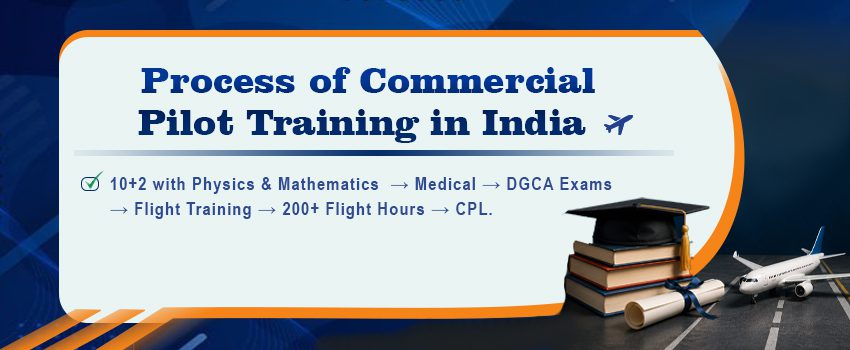
The training process is regulated by the Directorate General of Civil Aviation (DGCA). For a CPL, an applicant must meet the prescribed educational, medical, examination and flying-experience requirements. The DGCA’s published requirements include 10+2 with Physics and Mathematics, medical fitness, prescribed examinations and at least 200 hours of aeroplane flight time for the standard CPL route.
For students planning to become airline pilots, commercial pilot training is an important first stage. However, obtaining a CPL does not by itself guarantee an airline job; airlines may have additional selection, type-rating, experience and medical requirements.
Quick Answer: How to Become a Commercial Pilot in India?
The commercial pilot training process generally follows these steps:
- Complete 10+2 with Physics and Mathematics.
- Check your eligibility for pilot training.
- Complete the required DGCA medical assessment.
- Register as a Flight Crew Candidate and complete applicable DGCA processes.
- Choose a suitable DGCA-approved flying training organisation.
- Complete ground school and theoretical training.
- Clear the required DGCA examinations.
- Complete practical flying training.
- Complete the required cross-country, instrument and night flying experience.
- Complete the required skill tests and documentation.
- Apply for the Commercial Pilot Licence.
- After obtaining the CPL, pursue additional airline-oriented requirements such as type rating and airline selection, where applicable.
Step 1: Complete Your 10+2 Education
The first major educational requirement for a commercial pilot licence in India is completing Class 12 or an equivalent examination with Physics and Mathematics from a recognised board or university. DGCA’s Pariksha FAQ also states that candidates other than PPL applicants must have passed 10+2 with Physics and Mathematics or an equivalent qualification.
Therefore, students who want to pursue commercial pilot training should ideally select the PCM combination in Class 11 and 12.
Can a Student Become a Pilot After Class 12?
Yes. A student can begin the commercial pilot training pathway after completing the required 10+2 qualification. Individual flying schools may have additional admission criteria, so students should check the requirements of the specific training organisation before enrolling.
Step 2: Check Your Age Eligibility
For the issue of a Commercial Pilot Licence, the applicant must be at least 18 years old on the date of application under the published requirements.
Some flying academies may allow eligible students to begin training before they reach 18, subject to their own admission rules and the applicable licensing requirements. For example, IGRUA currently states that its ab-initio CPL course has a minimum joining age of 17 years.
This means students should distinguish between:
- Age to start training
- Age to apply for the CPL
- Age and other requirements for airline employment
These are not necessarily the same.
Step 3: Complete Your Pilot Medical Examination
Medical fitness is one of the most important parts of the commercial pilot training process.
Before investing heavily in flight training, students should understand the applicable DGCA medical requirements. The published CPL requirements require an applicant to produce a prescribed medical fitness certificate from an approved Medical Board.
Students should therefore complete the relevant medical assessment early rather than waiting until after substantial expenditure on training.
Why Is Pilot Medical Testing Important?
Pilot medical examinations assess whether a candidate meets the physical and medical standards required for flight crew licensing.
For students planning an airline career, medical fitness should be treated as an early-stage eligibility check, not as something to consider only after completing flying training.
Step 4: Register as a Flight Crew Candidate
DGCA operates the Pariksha system for flight crew examinations and related candidate processes.
DGCA’s Pariksha FAQ states that the minimum educational qualification for flight crew candidates, except PPL candidates, is 10+2 with Physics and Mathematics or an equivalent qualification. It also states that there is no maximum age limit for registering as a Flight Crew Candidate on the Pariksha portal.
Candidates should follow the latest DGCA instructions regarding registration, documentation and examinations because regulatory procedures can be updated.
Step 5: Choose a Suitable Flying Training Organisation
Choosing the right flying school is one of the most important decisions in commercial pilot training.
Students should evaluate a training organisation based on factors such as:
- DGCA approval and current regulatory status
- Aircraft availability
- Fleet condition and maintenance support
- Instructor availability
- Flying schedule
- Training infrastructure
- Simulator facilities
- Ground-school facilities
- Student-to-instructor ratio
- Historical training performance
- Average time taken by students to complete training
- Fee structure and refund policies
- Accommodation and other additional expenses
DGCA maintains information and regulatory resources related to aviation training organisations. Students should verify the current approval status before making a financial commitment.
Step 6: Complete Ground School Training
Commercial pilot training is not limited to flying an aircraft. A significant part of the programme involves theoretical and ground training.
Typical subjects include:
Air Navigation
Students learn how to plan and conduct flights, understand charts, calculate routes and apply navigation principles.
Aviation Meteorology
Meteorology helps pilots understand weather conditions, forecasts, visibility, wind, pressure systems, thunderstorms and other factors that influence flight operations.
Air Regulations
Students learn the aviation rules and regulations that govern flight operations and pilot responsibilities.
Aircraft and Engine Technical
This area covers aircraft systems, engines, instruments, limitations and technical knowledge required for safe operation.
Radio Communication
Effective communication is an essential part of flight operations. Students learn aviation communication procedures and applicable radio requirements.
For example, IGRUA’s current approved-course information lists ground training in Air Navigation, Radio Aids, Aviation Meteorology, Technical General and Air Regulations as part of its ab-initio CPL programme.
Step 7: Clear the Required DGCA Examinations
Students must prepare for and pass the applicable DGCA examinations associated with the CPL pathway.
The published CPL requirements specify examinations covering areas including:
- Air Regulations
- Air Navigation
- Meteorology
- Aircraft and Engines
- Signals practical examination
Strong preparation in Physics, Mathematics, aviation concepts and technical subjects can help students transition more effectively into pilot training.
Step 8: Start Practical Flying Training
Once the required initial training and procedures are completed, students progress to practical flight training.
The flying stage typically develops skills progressively, starting with basic aircraft handling and moving towards more advanced exercises.
A student may progress through stages such as:
Pre-flight training → Dual flying → Solo flying → Navigation exercises → Cross-country flying → Instrument training → Night flying → Advanced flight training
The exact sequence and training schedule can vary according to the training organisation, aircraft availability, weather and individual student progress.
Step 9: Complete the Required Flying Hours
Flying experience is a core requirement for obtaining a CPL.
The published requirements specify a minimum of 200 hours of aeroplane flight time within the five years immediately preceding the licence application. These hours include specific requirements for Pilot-in-Command, cross-country, instrument and night flying.
200 Hours of Total Flight Time
A standard CPL applicant must produce evidence of at least 200 hours of flight time in aeroplanes.
100 Hours as Pilot-in-Command
At least 100 hours must be as Pilot-in-Command (PIC), including the prescribed recent-flight requirement.
Cross-Country Flying
The requirements include at least 20 hours of cross-country flight time as PIC, including a cross-country flight of at least 300 nautical miles with full-stop landings at two different aerodromes.
Instrument Flying
The CPL requirements include at least 10 hours of instrument time, of which no more than five hours may be completed on an approved simulator.
Night Flying
The requirements also include at least 5 hours of night flight, including a minimum of 10 take-offs and 10 landings as PIC, subject to the prescribed recent-experience conditions.
Step 10: Complete Skill Tests and Required Documentation
After completing the required theoretical and flying training, candidates need to complete the applicable practical assessments, skill tests and documentation required for licence issuance.
The exact documents and procedural requirements can depend on the candidate’s training route and current DGCA rules.
Candidates should always check the latest DGCA instructions rather than relying solely on older checklists or information provided by unofficial websites.
Step 11: Apply for the Commercial Pilot Licence
After meeting the applicable educational, medical, examination and flying requirements, the candidate can proceed with the CPL application process.
The licence application requires evidence that the prescribed requirements have been fulfilled, including the required flying experience and medical fitness.
Once the licence is issued, the candidate becomes a licensed commercial pilot subject to the privileges, limitations, ratings and validity requirements applicable under DGCA regulations.
Step 12: Prepare for an Airline Pilot Career
Getting a CPL is an important milestone, but it is not necessarily the final step for someone targeting an airline cockpit.
Airline-focused candidates may need to pursue additional requirements depending on the airline and aircraft type.
These can include:
- Instrument rating
- Multi-engine training
- Type rating
- Airline selection preparation
- Simulator assessment
- Technical interview preparation
- HR interview preparation
- Additional flying experience
- Current medical fitness
For example, IGRUA’s current selection information says applicants seeking selection in an airline in India must be CPL holders and notes that a type rating is preferable and Class I medical fitness is expected.
Commercial Pilot Training in India: Step-by-Step Timeline
The overall pathway can be understood as:
10+2 with Physics & Mathematics
↓
Medical assessment
↓
Flight Crew/DGCA examination registration
↓
Select suitable flying training organisation
↓
Ground school
↓
DGCA examinations
↓
Practical flying training
↓
Solo & PIC flying
↓
Cross-country flying
↓
Instrument & night flying
↓
Required skill tests and documentation
↓
CPL application
↓
Commercial Pilot Licence
↓
Type Rating / Airline Selection / Further Career Training
How Long Does Commercial Pilot Training Take in India?
The duration is not identical for every student.
Training time can be affected by:
- Weather conditions
- Aircraft availability
- Instructor availability
- Airport operational constraints
- Student performance
- Examination schedules
- Maintenance downtime
- Flying slots
- Training organisation’s operational capacity
Therefore, students should be cautious about choosing a flying school solely because it promises an unusually short completion period.
How Much Does Commercial Pilot Training Cost in India?
The total cost varies significantly between training organisations and depends on the aircraft fleet, flying hours, simulator training, accommodation, examination fees and other services.
Students should ask for a complete cost breakup rather than comparing only the advertised tuition or flying fee.
Important cost components may include:
- Ground training
- Flying hours
- Aircraft charges
- Instructor charges
- Simulator training
- Examination fees
- Medical examination
- Licence-related fees
- Study material
- Uniform and equipment
- Accommodation
- Food and living expenses
- Travel
- Additional flying hours, if required
For example, IGRUA currently lists a course cost of ₹45 lakh for its CPL programme and separately identifies boarding/lodging and certain other expenses. This illustrates why students should compare the total programme cost rather than looking only at one headline fee.
What Should Students Check Before Joining a Flying School?
Before paying admission or training fees, ask the following questions:
- Is the flying training organisation currently approved by DGCA?
- How many aircraft are operational?
- How many instructors are available?
- What is the average monthly flying availability?
- What happens when an aircraft is under maintenance?
- Are simulator facilities available?
- Are examination and ground-training fees included?
- What expenses are excluded from the advertised fee?
- What is the refund policy?
- How many students are currently waiting for flying slots?
- What is the average time taken to complete the CPL requirements?
- Are accommodation and transportation included?
- What additional charges can arise if a student needs extra flying hours?
Commercial Pilot Training vs Airline Pilot Training
These terms are often used interchangeably, but they are not exactly the same.
Commercial pilot training focuses on meeting the requirements for a Commercial Pilot Licence.
Airline pilot preparation can go beyond the CPL and may include additional ratings, type-specific training, airline selection preparation and other requirements.
Therefore, students should ask whether a programme is designed only to obtain the CPL or whether it also provides additional airline-oriented training.
Frequently Asked Questions
What is the first step to become a commercial pilot in India?
The first major academic step is completing 10+2 or an equivalent qualification with Physics and Mathematics. Students should also address the applicable medical requirements early in the process.
How many flying hours are required for a CPL in India?
The published CPL requirements specify at least 200 hours of aeroplane flight time, with additional requirements for PIC, cross-country, instrument and night flying.
Is Physics and Mathematics compulsory for commercial pilot training?
For the standard CPL pathway, 10+2 with Physics and Mathematics is a prescribed educational requirement.
Is a medical examination required for CPL?
Yes. Medical fitness is part of the CPL licensing requirements, and the applicant must provide the prescribed medical fitness certification from an approved medical authority.
Can I start pilot training before turning 18?
Some training organisations may permit eligible students to start training before 18, subject to their admission and regulatory requirements. However, the published requirement for issue of a CPL states that the applicant must be at least 18 years old on the date of application.
Does a CPL guarantee an airline pilot job?
No. A CPL is an essential qualification for many commercial flying careers, but airline employment depends on additional requirements such as airline selection, medical fitness, aircraft-specific qualifications, experience and the airline’s recruitment criteria.
Can I become an airline pilot after completing CPL?
Yes. A CPL can be an important foundation for an airline career. Candidates may then need additional training and qualifications, such as type rating, along with meeting the specific requirements of the airline they are applying to.
Final Takeaway
The commercial pilot training process in India is a structured pathway that combines academic eligibility, medical fitness, ground-school education, DGCA examinations and practical flight training.
The most important milestone is obtaining the CPL after fulfilling the applicable DGCA requirements. For the standard aeroplane CPL route, the published requirements include 10+2 with Physics and Mathematics, medical fitness, prescribed examinations and at least 200 hours of flight experience, including specific PIC, cross-country, instrument and night-flight requirements.
Students should therefore plan their pilot career in stages: education → medical → ground training → examinations → flying training → CPL → additional airline-oriented qualifications → airline selection.
Because aviation regulations and training procedures can change, candidates should verify the latest requirements directly through DGCA before making admission or financial decisions. DGCA provides its regulatory and flight-crew examination resources through its official portals.