
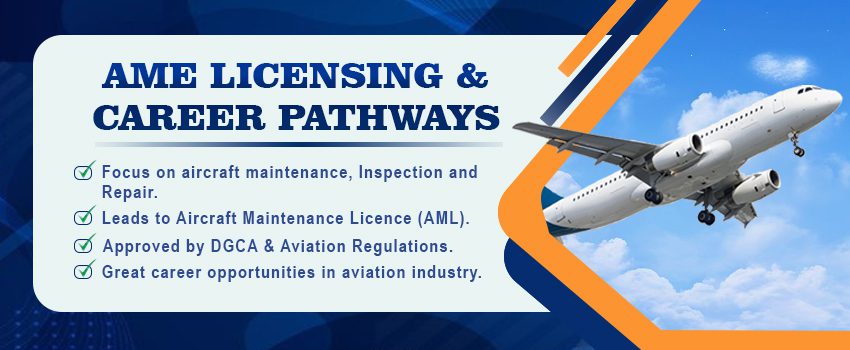
Aircraft Maintenance Engineering (AME) is often considered a challenging aviation course because it involves technical subjects, aircraft systems, practical training, safety procedures, and aviation regulations. However, AME is not necessarily difficult for an average PCM student. A student with a basic understanding of Physics and Mathematics, regular study habits, technical interest, and willingness to learn practical concepts can successfully pursue an AME course.
The difficulty level of AME depends less on whether a student is a topper and more on their conceptual understanding, consistency, practical learning ability, attention to detail, and interest in aircraft technology.
Is AME Difficult for Average Students?
No, AME is not too difficult for an average student who has a basic foundation in Physics and Mathematics and is prepared to study consistently. The course does involve technical concepts, but students learn these concepts progressively through classroom instruction, practical training, aircraft systems, maintenance procedures, and hands-on activities.
Students should understand that AME is different from a conventional academic course. It combines theoretical knowledge with practical and technical training. Therefore, students who are comfortable learning through both books and practical activities can adapt well to the course.
Why Do Students Think AME Is Difficult?
AME can initially appear difficult because students encounter aviation terminology, aircraft components, engineering concepts, electrical systems, mechanical systems, maintenance procedures, and regulatory requirements.
Another reason is that aircraft maintenance is a safety-critical field. Students must understand technical information accurately and follow prescribed procedures carefully. However, this does not mean that students need to be exceptionally intelligent. It means they need to be disciplined, attentive, and consistent.
Once students understand the fundamentals and become familiar with aircraft systems, many concepts become easier to understand.
Is AME Difficult for PCM Students?
Students from the PCM background already have exposure to Physics and Mathematics, which can provide a useful foundation for Aircraft Maintenance Engineering.
Physics helps students understand concepts related to mechanics, forces, electricity, energy, motion, pressure, and other technical principles. Mathematics helps develop analytical and problem-solving skills required for technical subjects.
Chemistry may also form part of the academic background depending on the eligibility and program requirements. However, students do not need to be experts in every PCM topic before joining AME.
The most important factor is having a willingness to strengthen technical fundamentals during the course.
What Makes AME Challenging?
Several aspects of AME can require additional effort from students.
1. Technical Subjects
AME involves technical subjects related to aircraft structures, engines, electrical systems, avionics, materials, maintenance practices, and aircraft systems. Students need to understand concepts rather than simply memorize information.
2. Aircraft Systems
Modern aircraft contain highly interconnected systems. Students need to understand how different components operate and how faults can affect aircraft systems.
3. Practical Training
AME is not limited to classroom study. Students also need practical exposure and must learn how maintenance procedures are performed according to approved technical instructions.
4. Aviation Regulations
Aircraft maintenance is governed by strict safety and regulatory requirements. Students need to understand applicable aviation rules, procedures, documentation, and maintenance standards.
5. Attention to Detail
Aircraft maintenance requires precision. Students must develop the habit of checking technical information carefully and following maintenance procedures accurately.
Does AME Require Strong Physics and Mathematics?
A strong foundation in Physics and Mathematics can certainly help students during AME training. However, students do not necessarily need exceptionally high marks in these subjects to understand the course.
The important thing is to have a reasonable understanding of fundamental concepts and improve them when required. Students who find Physics or Mathematics difficult should focus on basics such as mechanics, electricity, measurements, formulas, units, and problem-solving.
Regular practice can make technical subjects much easier over time.
Can an Average Student Become an Aircraft Maintenance Engineer?
Yes, an average student can build a career in aircraft maintenance. Academic performance is only one part of the overall learning process.
A successful AME professional also needs qualities such as:
- Technical curiosity
- Practical learning ability
- Discipline
- Attention to detail
- Safety awareness
- Problem-solving skills
- Responsibility
- Ability to follow procedures
- Willingness to keep learning
A student who consistently works on these skills can progress successfully even if they were not among the top scorers in school.
Is AME More Practical or Theoretical?
AME involves both theoretical learning and practical training. Students need to understand the theory behind aircraft systems and then develop practical knowledge related to maintenance activities.
This combination can actually make AME easier for students who do not enjoy purely theoretical education. Students who prefer understanding how machines work and learning through practical exposure may find AME particularly interesting.
How Can an Average Student Prepare for AME?
Students can make AME easier by preparing their technical fundamentals before and during the course.
Focus on Physics Fundamentals
Revise basic concepts of mechanics, electricity, energy, pressure, motion, forces, and related topics. Understanding concepts is more useful than memorizing formulas without knowing how they work.
Strengthen Mathematics
Practice basic calculations, algebra, measurements, ratios, graphs, and other mathematical concepts that support technical learning.
Develop Technical Curiosity
Students should develop an interest in aircraft and understand basic aircraft components such as engines, wings, landing gear, flight controls, electrical systems, and avionics.
Study Regularly
Instead of studying everything immediately before examinations, students should revise technical subjects regularly. Consistent learning makes complex concepts easier to retain.
Take Practical Training Seriously
Practical training is an important part of aircraft maintenance education. Students should actively participate in practical sessions and try to understand why each maintenance procedure is performed.
Is AME CEE Difficult for Average Students?
For students applying through AME CEE, preparation should focus on the examination syllabus and the relevant subjects specified for the particular admission session.
An average PCM student can prepare for an AME entrance examination by developing a structured study plan, revising fundamental concepts, solving practice questions, taking mock tests, and identifying weak areas.
The goal should not be to study everything at once. Students should build their preparation gradually and focus on accuracy and conceptual clarity.
How Many Hours Should an Average Student Study for AME?
There is no fixed number of hours that every student must study. The ideal study time depends on the student’s current academic level, course requirements, and learning speed.
For entrance preparation, a student can create a daily schedule that combines concept revision, question practice, mock tests, and revision of difficult topics.
For AME coursework, regular daily study is generally more effective than long but irregular study sessions.
What Are the Most Difficult Parts of AME?
The difficulty varies from student to student, but students commonly need additional effort in areas involving:
- Aircraft systems
- Avionics and electrical concepts
- Aircraft engines
- Technical documentation
- Aviation regulations
- Maintenance procedures
- Technical calculations
- Practical examinations
These subjects become easier when students understand the underlying concepts and connect classroom learning with practical aircraft maintenance.
Is AME Harder Than Aeronautical Engineering?
AME and Aeronautical Engineering have different academic and professional objectives, so it is not accurate to say that one is universally harder than the other.
AME focuses strongly on aircraft maintenance, inspection, troubleshooting, practical training, safety, and the applicable licensing pathway.
Aeronautical Engineering is a broader engineering discipline that can cover areas such as aerodynamics, aircraft structures, propulsion, flight mechanics, design, manufacturing, and related engineering subjects.
Students should choose between them based on their career interests rather than simply choosing the course they believe will be easier.
Is AME Suitable for an Average PCM Student?
AME can be suitable for an average PCM student who has an interest in aviation and is willing to work consistently. Students do not need to be academic toppers, but they should be prepared to learn technical subjects and follow safety-oriented procedures carefully.
A student who is weak in some PCM topics can improve those areas through additional study. The important thing is to have a positive learning attitude and remain consistent throughout the course.
What Skills Should an AME Student Develop?
Apart from academic knowledge, students should develop practical and professional skills that are important in aircraft maintenance.
Technical Knowledge
Students should understand aircraft components, systems, engines, electrical systems, avionics, structures, and maintenance concepts relevant to their training.
Problem-Solving
Aircraft maintenance professionals need to identify problems, understand technical information, and follow appropriate troubleshooting procedures.
Attention to Detail
Even a small maintenance error can have serious consequences. Developing accuracy and attention to detail is therefore essential.
Communication
Aircraft maintenance involves working with engineers, technicians, pilots, supervisors, and other aviation professionals. Clear communication is important for safe operations.
Discipline and Safety Awareness
Students must understand that aviation maintenance is a highly safety-sensitive profession. Following procedures and maintaining professional discipline are essential.
Is AME a Good Career for Average Students?
AME can be a good career option for students who are interested in aviation, aircraft technology, mechanical systems, electrical systems, and practical technical work.
Career opportunities can exist across airlines, Maintenance, Repair and Overhaul (MRO) organizations, aircraft maintenance organizations, aviation companies, and related technical sectors, subject to the candidate’s training, qualifications, licensing status, experience, and employer requirements.
Students should research the current regulatory requirements and career pathway before choosing an AME program.
AME Difficulty Level: Quick Answer
Is AME difficult?
AME can be technically demanding, but it is manageable for students who study consistently and understand the concepts.
Can an average PCM student do AME?
Yes. An average PCM student can pursue AME if they meet the applicable eligibility requirements and are willing to develop their technical knowledge.
Do I need to be a topper for AME?
No. Being a topper is not a requirement for becoming successful in AME. Consistency, technical understanding, practical skills, and discipline are highly important.
Is Physics important for AME?
Yes. Physics provides a useful foundation for understanding many aircraft and engineering concepts.
Is Mathematics difficult in AME?
The level of mathematical difficulty depends on the subjects and program. Students with a basic mathematical foundation can improve their skills through regular practice.
Is practical training difficult in AME?
Practical training requires attention, accuracy, and adherence to procedures. Students generally become more comfortable as they gain hands-on experience.
Frequently Asked Questions About AME Difficulty
1. Is AME difficult for average PCM students?
No. AME is manageable for average PCM students who have basic technical knowledge, study consistently, and take practical training seriously.
2. Can a weak student become an Aircraft Maintenance Engineer?
A student who is currently weak in some subjects can improve through structured study and practice. However, they must meet the applicable eligibility, training, examination, and licensing requirements.
3. Is AME harder than 12th PCM?
AME is different from Class 12 PCM. It introduces specialized aviation and aircraft maintenance subjects along with practical training, so students may initially find some topics unfamiliar.
4. Does AME require advanced Mathematics?
Students need an appropriate mathematical foundation for their training, but they do not necessarily need advanced mathematics comparable to every engineering specialization.
5. What is more important in AME: marks or skills?
Both academic knowledge and practical skills matter. However, technical understanding, safety awareness, accuracy, discipline, and practical competence are especially important in aircraft maintenance.
6. How can I make AME easier?
Build strong Physics and Mathematics fundamentals, study regularly, practice questions, participate actively in practical sessions, revise technical concepts, and ask instructors about topics you do not understand.
7. Can an average student crack AME CEE?
Yes, with structured preparation. Students should understand the syllabus, revise fundamentals, practice questions, take mock tests, and maintain consistency.
8. Is AME suitable for students who do not like theory?
AME includes theoretical as well as practical learning. Students who prefer practical and technical learning may enjoy the course, but they still need to study and understand theoretical concepts.
Final Verdict: Is AME Difficult for Average PCM Students?
AME is not too difficult for an average PCM student if the student has an interest in aviation, understands the basic concepts of Physics and Mathematics, and is willing to study consistently. The course requires technical knowledge, practical competence, discipline, attention to detail, and a strong commitment to aviation safety.
Students should not decide against AME simply because they are average in academics. Instead, they should evaluate their interest in aircraft maintenance, technical learning, practical work, and aviation as a career.
With the right preparation, regular practice, practical exposure, and guidance, an average PCM student can develop the knowledge and skills needed to progress through AME training and work toward the applicable aircraft maintenance licensing pathway.