
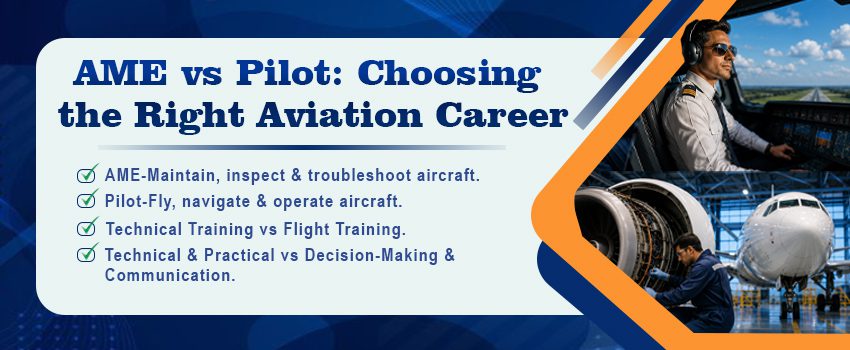
The aviation industry offers several exciting career opportunities, but two of the most popular choices among students are Aircraft Maintenance Engineering (AME) and becoming a Pilot. Both careers are directly connected with aircraft and aviation, but their responsibilities, education, training, licensing, working environment, and career paths are very different.
So, AME vs Pilot—which aviation career is right for you? The answer depends on your interests and career goals. If you enjoy aircraft technology, engineering systems, troubleshooting, maintenance, and technical work, AME may be a better choice. If you are passionate about flying, cockpit operations, navigation, decision-making, and working as part of a flight crew, becoming a pilot may be more suitable.
AME vs Pilot: Quick Answer
AME is primarily a technical aircraft maintenance career, while a pilot is responsible for operating and flying an aircraft. An AME professional works on aircraft systems, maintenance, inspections, troubleshooting, and safety-related technical activities within the applicable regulatory and licensing framework. A pilot operates the aircraft, manages flight operations, follows flight procedures, and is responsible for the safe conduct of the flight within their licensed privileges.
Neither career is universally better than the other. The right choice depends on whether you want to maintain aircraft or fly aircraft.
What Is Aircraft Maintenance Engineering?
Aircraft Maintenance Engineering (AME) is a specialized aviation field focused on maintaining aircraft in safe and serviceable condition. AME training involves learning about aircraft systems, engines, structures, electrical systems, avionics, maintenance procedures, technical documentation, and aviation regulations.
The professional pathway is closely connected with aircraft maintenance licensing requirements. Depending on the applicable category and regulatory framework, AME professionals can perform or certify maintenance-related tasks within the privileges granted by their licence.
AME is therefore a strong option for students who enjoy technical subjects, aircraft systems, mechanical or electrical concepts, practical work, and problem-solving.
What Does an Aircraft Maintenance Engineer Do?
An aircraft maintenance professional can be involved in activities such as:
- Aircraft inspection
- Maintenance and servicing
- Troubleshooting technical defects
- Component replacement
- Aircraft system checks
- Maintenance documentation
- Safety inspections
- Following approved maintenance procedures
- Certification-related activities within applicable licence privileges
Aircraft maintenance is a safety-critical profession. Professionals must follow approved procedures and applicable aviation regulations accurately.
What Is a Pilot?
A pilot is an aviation professional trained and licensed to operate an aircraft. Pilots are responsible for preparing for flights, operating aircraft systems, navigating, communicating with air traffic control, monitoring aircraft performance, responding to operational situations, and ensuring the safe conduct of flights within their licence and aircraft type qualifications.
Becoming a professional pilot generally requires structured flight training, examinations, medical fitness requirements, practical flying experience, and the appropriate pilot licence and ratings.
What Does a Pilot Do?
A pilot’s responsibilities can include:
- Pre-flight preparation
- Aircraft operation
- Navigation
- Communication with air traffic control
- Monitoring aircraft systems
- Managing flight procedures
- Weather assessment
- Crew coordination
- Passenger safety
- Responding to in-flight situations
- Post-flight procedures
Pilots must make accurate decisions while operating in a highly regulated and safety-sensitive environment.
AME vs Pilot: Major Difference
The simplest way to understand the difference is:
AME = Aircraft Maintenance
Pilot = Aircraft Operation
An AME works primarily on the technical condition and maintenance of an aircraft, while a pilot operates the aircraft during flight.
Both professionals play essential roles in aviation safety, but they contribute to aviation from different sides of the operation.
AME vs Pilot: Career Comparison
| Factor | AME | Pilot |
| Primary Role | Aircraft maintenance | Aircraft operation |
| Main Focus | Aircraft systems and maintenance | Flying and flight operations |
| Training | Technical and practical aviation training | Flight and theoretical training |
| Licence | Aircraft maintenance licence pathway | Pilot licence pathway |
| Work Environment | Hangar, maintenance facility, airport | Aircraft cockpit, airport |
| Practical Work | Aircraft maintenance and inspection | Flight operations |
| Key Skills | Technical knowledge, troubleshooting, precision | Flying skills, decision-making, communication |
| Aviation Area | Maintenance | Flight operations |
| Suitable For | Students interested in aircraft technology | Students interested in flying |
AME vs Pilot: Which Course Is More Difficult?
Both career paths can be challenging, but they involve different types of difficulty.
AME requires students to understand aircraft systems, maintenance procedures, technical subjects, practical tasks, and aviation regulations. Students need strong attention to detail and technical discipline.
Pilot training requires theoretical aviation knowledge as well as extensive practical flying. Students need to develop flying skills, decision-making ability, communication skills, situational awareness, and the ability to operate safely under different conditions.
Therefore, it is not accurate to say that AME is easier than becoming a pilot or that pilot training is always harder than AME. The difficulty depends on the individual’s interests, abilities, preparation, and learning style.
AME vs Pilot: Eligibility After 12th
Students planning an aviation career after Class 12 should first check the eligibility requirements for their chosen pathway.
For AME, eligibility commonly involves a science background, particularly Physics and Mathematics, depending on the specific program and applicable regulations. Students should verify the current requirements of the approved training organization.
For pilot training, eligibility depends on the type of pilot licence and the applicable aviation authority. Candidates generally need to satisfy educational, medical, age, examination, and flight-training requirements.
Because aviation regulations can change, students should always verify the latest official requirements before admission.
AME vs Pilot: Which One Is Better After 12th PCM?
For a PCM student, both AME and pilot training can be possible career directions, subject to meeting the applicable eligibility requirements.
Students who enjoy Physics, Mathematics, mechanical systems, electrical systems, aircraft technology, and practical technical work may find AME more suitable.
Students who are passionate about flying, navigation, aircraft operation, decision-making, communication, and cockpit responsibilities may prefer pilot training.
The best career is therefore the one that matches the student’s interests and long-term goals.
AME vs Pilot: Which Career Has Better Salary?
Salary should not be the only factor when choosing between AME and pilot careers. Earnings can vary significantly depending on experience, licence status, aircraft type, employer, location, seniority, and other professional qualifications.
Pilots can potentially earn high salaries as they gain experience and progress into senior flight positions, but pilot training can also involve significant financial investment.
AME professionals can also progress financially as they gain maintenance experience, relevant licences, aircraft type qualifications, and senior technical responsibilities.
Students should compare training costs, career progression, qualification requirements, employment opportunities, and long-term earning potential rather than looking at starting salary alone.
AME vs Pilot: Which Career Has Better Job Opportunities?
Both careers are connected to the aviation ecosystem and can offer opportunities across airlines, airports, maintenance organizations, aviation companies, and related sectors.
Pilot opportunities depend heavily on airline hiring cycles, licence requirements, aircraft type qualifications, experience, and market conditions.
AME opportunities are connected with aircraft maintenance organizations, airlines, MRO companies, and other aviation maintenance operations. Demand can also depend on fleet growth, aviation activity, regulatory requirements, and industry conditions.
Students should research current employment trends before making a career decision.
AME vs Pilot: Work Environment
The working environments of AME professionals and pilots are quite different.
AME professionals may spend significant time in aircraft hangars, maintenance facilities, airports, workshops, or other technical environments. Their work can involve inspections, maintenance tasks, troubleshooting, documentation, and coordination with other technical professionals.
Pilots primarily work in the cockpit and aviation operational environment. Their schedules can involve early mornings, nights, weekends, long-distance travel, and varying duty patterns depending on the employer and type of operation.
AME vs Pilot: Which Career Requires More Practical Training?
Both careers require substantial practical learning, but the nature of the practical training is different.
AME students develop practical skills related to aircraft maintenance, tools, components, systems, inspection procedures, troubleshooting, and maintenance practices.
Pilot students develop practical flying skills through flight training, including aircraft handling, navigation, communication, emergency procedures, and operational decision-making.
Therefore, both careers are strongly practical but in different ways.
AME vs Pilot: Which Career Is Better for Students Who Like Technology?
AME is generally more suitable for students who are particularly interested in aircraft technology and technical systems.
Students who enjoy understanding how engines, aircraft structures, electrical systems, avionics, and other components work may find AME appealing.
Pilots also need strong technical knowledge because modern aircraft are highly sophisticated machines. However, their primary professional responsibility is aircraft operation rather than maintenance.
AME vs Pilot: Which Career Is Better for Students Who Love Flying?
If your primary dream is to sit in the cockpit and fly an aircraft, pilot training is the more direct career pathway.
If you enjoy aircraft but are more interested in understanding, maintaining, inspecting, and troubleshooting aircraft systems, AME may be the better fit.
A simple question can help:
Do you want to fly the aircraft or work on the aircraft?
If the answer is fly, explore the pilot pathway.
If the answer is to maintain and work on aircraft systems, explore AME.
Can an AME Become a Pilot?
AME and pilot are separate professional pathways with different training and licensing requirements. Completing AME training does not automatically qualify someone to become a pilot.
An AME professional who later wants to become a pilot would need to meet the applicable pilot eligibility requirements and complete the required theoretical and flight training for the relevant pilot licence.
Can a Pilot Become an AME?
Similarly, holding a pilot licence does not automatically qualify someone as an aircraft maintenance professional.
A pilot interested in aircraft maintenance would need to complete the applicable AME training, examinations, practical experience, and licensing requirements.
AME vs Pilot: Which Career Is Safer?
Both AME and pilot careers operate within highly regulated aviation safety systems. Safety is a fundamental responsibility in both professions.
AME professionals contribute to safety by ensuring aircraft maintenance is performed according to approved procedures and applicable regulations.
Pilots contribute to safety through correct aircraft operation, flight planning, decision-making, communication, crew coordination, and compliance with operational procedures.
Instead of asking which career is safer, students should understand that both careers require strong safety awareness and professional discipline.
AME vs Pilot: Which Career Has More Responsibility?
Both careers carry significant responsibility, but the nature of the responsibility differs.
An AME professional is responsible for performing or certifying maintenance-related work within their applicable privileges and ensuring that technical procedures are followed correctly.
A pilot is responsible for operating the aircraft and making operational decisions during flight within the scope of their licence and responsibilities.
Both roles are essential to maintaining aviation safety.
Who Should Choose AME?
AME may be suitable if you:
- Enjoy aircraft and aviation technology
- Like Physics and technical subjects
- Enjoy mechanical or electrical systems
- Prefer practical technical work
- Like troubleshooting problems
- Have strong attention to detail
- Are comfortable following technical procedures
- Want a career in aircraft maintenance
- Are interested in aviation safety
Who Should Choose Pilot Training?
Pilot training may be suitable if you:
- Have a strong passion for flying
- Want to operate aircraft
- Enjoy navigation and flight operations
- Have good decision-making skills
- Communicate confidently
- Can remain calm under pressure
- Are comfortable with irregular working schedules
- Are interested in cockpit operations
- Want a career directly connected with flying
AME vs Pilot: How to Make the Right Career Choice
Before choosing between AME and pilot training, ask yourself what type of aviation work you enjoy.
If you become excited when learning how an aircraft engine works, how avionics systems function, how aircraft components are maintained, or how technical faults are identified, AME could be a good fit.
If you are more interested in flying an aircraft, navigating, managing flight operations, communicating with air traffic control, and experiencing cockpit responsibilities, pilot training may be the better choice.
Students should also consider their academic background, financial planning, physical and medical requirements, training duration, licensing pathway, lifestyle preferences, and long-term career goals.
AME vs Pilot: Quick AEO Answers
Is AME better than becoming a pilot?
Neither career is universally better. AME is better suited to students interested in aircraft maintenance and technical systems, while pilot training is better suited to students who want to operate and fly aircraft.
Is AME easier than pilot training?
AME and pilot training involve different types of challenges. AME emphasizes technical and maintenance knowledge, while pilot training combines aviation theory with practical flying.
Can I become an AME after 12th PCM?
Eligible PCM students can pursue relevant AME pathways, subject to the current requirements of the approved training organization and applicable aviation regulations.
Can I become a pilot after 12th PCM?
PCM students may be eligible for relevant pilot training pathways, subject to the current educational, medical, age, examination, and licensing requirements.
Which is better for an aviation career: AME or pilot?
The answer depends on your career objective. Choose AME if you want to maintain aircraft; choose pilot training if you want to fly aircraft.
Which has better salary, AME or pilot?
Earnings vary according to experience, qualifications, employer, licence status, aircraft type, and seniority. Pilot salaries can become substantial with experience, while AME professionals can also progress as they gain licences, experience, and technical qualifications.
Is AME a good career?
AME can be a suitable aviation career for students interested in aircraft maintenance, technical systems, practical work, and aviation safety.
Is becoming a pilot a good career?
Pilot training can be a rewarding career for students who are passionate about flying and are prepared to meet the required training, licensing, medical, and financial commitments.
AME vs Pilot: Final Verdict
AME and Pilot are both important aviation careers, but they serve different purposes. AME focuses on aircraft maintenance, technical systems, inspection, troubleshooting, and aviation safety, while pilots focus on aircraft operation, flying, navigation, and flight safety.
If you love aircraft technology, engineering systems, maintenance, and practical technical work, AME may be the right career for you.
If you dream of flying aircraft and working in the cockpit, becoming a pilot may be the better choice.
The best aviation career is not necessarily the one with the highest salary or the most popular job title. It is the career that matches your interest, skills, financial plans, learning style, and long-term professional goals.
Before enrolling, students should verify the latest eligibility criteria, training requirements, licensing pathway, regulatory approvals, fees, and career opportunities from the relevant official authorities and training organizations.