
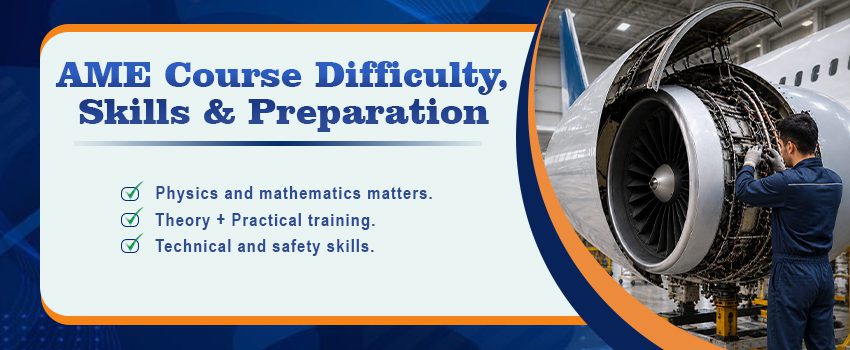
Aircraft Maintenance Engineering (AME) is one of the most specialized career options in the aviation industry. Students who are interested in aircraft maintenance often have an important question: Is AME a degree or diploma course? The answer is that AME is generally a professional aviation training and licensing pathway, not a conventional undergraduate degree such as B.Tech or B.Sc. The course focuses on practical and technical training required to work on aircraft maintenance and obtain the appropriate Aircraft Maintenance Licence (AML), subject to the applicable aviation authority and regulatory requirements.
Is AME a Degree or Diploma?
AME is not a conventional degree course. Aircraft Maintenance Engineering is a specialized professional training program designed to prepare students for aircraft maintenance licensing and related technical responsibilities. Depending on the institution and regulatory framework, AME training may be offered through approved training organizations and can have different academic structures or affiliations.
Students should therefore distinguish between the academic qualification they may receive and the aviation maintenance licence they work toward. Completing an AME training program does not automatically mean that a student receives a B.Tech or other traditional engineering degree.
What Is Aircraft Maintenance Engineering?
Aircraft Maintenance Engineering is a specialized aviation field concerned with maintaining aircraft in safe and serviceable condition. AME professionals are involved in inspection, maintenance, troubleshooting, repair, servicing, and certification-related activities according to applicable aviation regulations.
Unlike conventional engineering programs that primarily focus on academic engineering principles, AME training combines technical knowledge, practical maintenance skills, aircraft systems, safety procedures, and regulatory requirements. The ultimate objective is to prepare candidates for responsibilities associated with aircraft maintenance and licensing.
Is AME an Engineering Degree?
The word “Engineering” in Aircraft Maintenance Engineering can sometimes create confusion among students. AME is an engineering-related professional field, but it should not automatically be considered equivalent to a B.Tech in Aeronautical Engineering, Aerospace Engineering, or Mechanical Engineering.
A B.Tech is an academic undergraduate degree awarded by a recognized university or institution. AME, on the other hand, is primarily connected with aviation maintenance training and licensing requirements. Students considering AME should carefully check the approval, affiliation, licensing pathway, and qualification awarded by the particular institute before taking admission.
What Qualification Do You Get After an AME Course?
The qualification obtained after AME training depends on the specific program, institute, and applicable regulatory framework. In a regulated AME pathway, students receive training intended to meet the knowledge and practical experience requirements associated with aircraft maintenance licensing.
In India, students should specifically verify whether the AME institute and training program are approved by the Directorate General of Civil Aviation (DGCA) and understand what examinations, practical experience, and other requirements are necessary for the relevant licence or category.
Therefore, students should not select an AME institute only because it uses the word “degree” or “engineering” in its course description. The regulatory approval and licensing pathway are much more important when evaluating an AME program.
AME Course vs B.Tech Aeronautical Engineering
AME and B.Tech Aeronautical Engineering are related to aviation but lead toward different professional pathways.
Aircraft Maintenance Engineering focuses primarily on aircraft maintenance, inspection, troubleshooting, servicing, safety, and regulatory compliance. The training is closely connected with aircraft maintenance licensing.
B.Tech Aeronautical Engineering is an undergraduate engineering degree covering subjects such as aerodynamics, aircraft structures, propulsion, flight mechanics, avionics, and aircraft design and manufacturing. Graduates can pursue engineering, design, research, manufacturing, testing, and other aviation-related careers.
The better option depends on the student’s career objective. Students who specifically want to build a career in aircraft maintenance and maintenance licensing may consider AME, while students interested in broader engineering and aircraft design-related careers may consider an aeronautical engineering degree.
Is AME a Diploma?
AME should not simply be described as a diploma. Although some AME programs may be marketed with diploma-like terminology, the key factor is the regulatory framework and approval of the training organization rather than the label used in promotional material.
Students should check exactly what the institute offers, including the course structure, approval status, examinations, practical training, licence pathway, and final qualification. This prevents confusion between an academic diploma and professional aircraft maintenance training.
What Is the Difference Between AME and a Diploma in Engineering?
A conventional engineering diploma is generally an academic technical qualification. AME training, in contrast, is designed specifically around aircraft maintenance and the requirements of the applicable aviation regulator.
For example, a general mechanical engineering diploma may prepare a student for technical roles across manufacturing, maintenance, production, and engineering industries. AME training is much more specialized toward aircraft maintenance and aviation safety.
This specialization makes AME particularly relevant for students who already know that they want to work in aircraft maintenance.
Is AME a Good Career After 12th?
AME can be a suitable career option for students who have a strong interest in aircraft, aviation technology, mechanical systems, electrical systems, and hands-on technical work. Students who enjoy understanding how aircraft systems function and are comfortable following strict safety and technical procedures may find the field rewarding.
Before choosing the course, students should understand the complete pathway, including eligibility, approved training, examinations, practical experience, licensing requirements, and employment opportunities. A clear understanding of these requirements can help students make a better career decision.
Who Can Join an AME Course?
Eligibility depends on the specific AME program and applicable regulatory requirements. In general, students entering AME pathways in India commonly come from a 10+2 background with Physics, Chemistry, and Mathematics (PCM) or an equivalent eligible qualification.
However, eligibility can vary depending on the category, institute, and current regulatory requirements. Students should always verify the latest eligibility criteria directly with the approved training organization and relevant aviation authority before applying.
What Are the Main AME Categories?
Aircraft maintenance licensing can involve different categories and subcategories depending on the applicable regulatory system. In the Indian context, students may encounter Category B1 and Category B2 pathways.
B1 is generally associated with mechanical maintenance areas, including aircraft structure, powerplant, and mechanical and electrical systems. B2 is primarily associated with avionics and electrical systems.
The exact privileges, examinations, experience requirements, and licensing conditions depend on the applicable regulations. Students should understand these differences before selecting their preferred AME pathway.
What Does an Aircraft Maintenance Engineer Do?
An Aircraft Maintenance Engineer or licensed aircraft maintenance professional can have responsibilities related to aircraft inspection, maintenance, troubleshooting, defect rectification, component replacement, documentation, and certification within the privileges granted by the applicable licence.
Aircraft maintenance is a safety-critical profession. Professionals must follow approved maintenance procedures, technical documentation, safety standards, and aviation regulations. Accuracy and responsibility are therefore essential qualities for anyone considering an AME career.
Career Opportunities After AME
After completing the required training and meeting applicable licensing and experience requirements, AME professionals can pursue opportunities in areas such as airlines, Maintenance, Repair and Overhaul (MRO) organizations, aviation maintenance companies, aircraft operators, and other aviation-related organizations.
Career progression depends on factors such as licence status, aircraft type ratings, practical experience, technical specialization, employer requirements, and applicable aviation regulations.
AME Degree or Diploma: Quick Answer
Question: Is AME a degree or diploma?
Answer: AME is not a conventional undergraduate degree like B.Tech. It is primarily a specialized aircraft maintenance training and licensing pathway. The exact qualification associated with an AME program depends on the institute and applicable regulatory framework.
Question: Does AME give a B.Tech degree?
Answer: A standard AME training program should not be assumed to provide a B.Tech degree. Students should verify the exact academic qualification separately from the AME licensing pathway.
Question: Is AME equivalent to Aeronautical Engineering?
Answer: No. AME and Aeronautical Engineering are related to aviation but have different education, training, and career pathways.
Question: Is AME a professional course?
Answer: Yes. AME is a specialized professional pathway focused on aircraft maintenance, technical competency, aviation safety, and applicable licensing requirements.
Question: Can I join AME after 12th PCM?
Answer: Students with 12th PCM may be eligible for relevant AME pathways, subject to the current eligibility requirements of the approved training organization and aviation regulator.
Why Choose AME as a Career?
AME is a specialized career choice for students who want to work directly with aircraft maintenance and aviation technical operations. Unlike broad engineering courses, AME training is closely focused on aircraft systems, maintenance practices, safety, and aviation regulations.
The aviation sector requires trained technical professionals to maintain aircraft in accordance with strict safety standards. For students who are interested in aircraft technology and practical technical work, AME can provide a focused route into the aviation maintenance sector.
How to Choose the Right AME Institute?
Choosing the right AME institute is one of the most important decisions for students. Before taking admission, check the institute’s DGCA approval status, course category, training facilities, practical exposure, faculty, aircraft or maintenance training resources, examination support, placement information, and complete fee structure.
Students should also understand whether the course provides the training and examination pathway required for the licence they intend to pursue. Avoid choosing an institute solely on the basis of claims such as “degree course,” “100% placement,” or “international career.”
Final Verdict: Is AME a Degree or Diploma?
AME is neither simply a conventional degree nor an ordinary engineering diploma. It is a specialized aircraft maintenance training and licensing pathway. Its primary purpose is to develop the technical knowledge and practical competence required for aircraft maintenance and, subject to regulatory requirements, progression toward an Aircraft Maintenance Licence.
Students interested in aviation should compare AME with B.Tech Aeronautical Engineering, Aerospace Engineering, and other aviation courses based on their desired career. If the goal is specifically to work in aircraft maintenance and pursue the relevant maintenance licence, AME can be a focused career pathway.
Before admission, always verify the current regulatory approval, eligibility criteria, training structure, examinations, experience requirements, and qualification offered by the institute.
Frequently Asked Questions About AME
1. Is AME a degree course?
No. AME is not a conventional undergraduate degree such as B.Tech. It is a specialized aircraft maintenance training and licensing pathway.
2. Is AME a diploma course?
AME should not automatically be classified as a diploma. Students must check the exact program structure, approval, qualification, and licensing pathway offered by the institute.
3. Is AME equivalent to B.Tech?
No. AME and B.Tech are different educational and professional pathways. B.Tech is an academic engineering degree, whereas AME focuses on aircraft maintenance training and licensing.
4. Can I pursue AME after 12th?
Yes, eligible 12th-pass students can pursue relevant AME pathways, subject to the current eligibility requirements.
5. Is AME a good career in aviation?
AME can be a strong career option for students interested in aircraft maintenance, technical systems, aviation safety, and hands-on engineering work.
6. What is the difference between AME and Aeronautical Engineering?
AME primarily focuses on aircraft maintenance and licensing, while Aeronautical Engineering is a broader academic engineering discipline covering aircraft design, aerodynamics, propulsion, structures, manufacturing, and related areas.
7. Is AME regulated?
Aircraft maintenance training and licensing are regulated by the applicable aviation authority. In India, students should verify the relevant DGCA requirements and the approval status of the training organization before admission.
8. What should students check before joining AME?
Students should check the institute’s regulatory approval, eligibility requirements, course category, training facilities, examination pathway, practical experience requirements, fees, and career support before enrolling.