
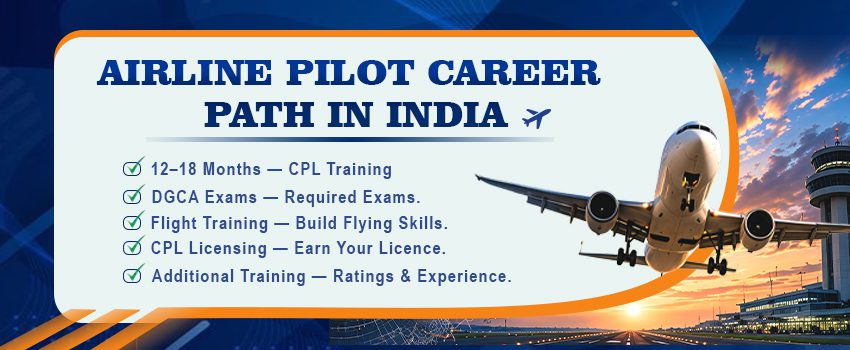
Becoming an airline pilot in India is a multi-stage process that involves Class 12 education, medical certification, DGCA examinations, flight training, obtaining a Commercial Pilot Licence (CPL), building the required experience, and completing airline-specific training and selection requirements. For a student starting after Class 12, the process can often take approximately 18 months to 3 years or more, depending on the training pathway, flying availability, examination progress, financial planning, additional qualifications, and airline hiring conditions.
It is important to understand that getting a CPL and becoming an airline pilot are not exactly the same thing. A CPL is a major professional pilot qualification, while an airline pilot career may require additional experience, ratings, airline selection, simulator assessments, aircraft-specific training, and other applicable requirements.
How Long Does It Take to Become an Airline Pilot in India?
For a student starting after Class 12, becoming an airline pilot can take around 18 months to 3 years or more in a smooth and continuous pathway. However, there is no fixed timeline for every student.
The timeline can be affected by:
- Ground training
- DGCA examinations
- Medical certification
- Flight training
- Weather conditions
- Aircraft availability
- Instructor availability
- Completion of required flying experience
- CPL processing
- Additional ratings
- Airline recruitment
- Simulator and aircraft-specific training
- Employment availability
Some students may complete their initial commercial pilot training relatively quickly, while others may take longer due to operational or personal factors.
What Is the Difference Between a CPL Holder and an Airline Pilot?
This is one of the most important points for students to understand.
A Commercial Pilot Licence (CPL) is a professional pilot licence that allows the holder to exercise commercial pilot privileges within the applicable regulatory framework.
An airline pilot works for an airline and operates aircraft as part of commercial airline operations, subject to the required licences, ratings, experience, medical fitness, company training, and other applicable requirements.
Therefore:
CPL = Important professional pilot qualification
Airline Pilot = Career role requiring further qualifications, experience and airline-specific requirements
Getting a CPL does not automatically guarantee an airline pilot job.
What Is the Complete Pathway to Become an Airline Pilot in India?
The journey can be divided into several major stages.
Step 1: Complete Class 12
Students generally begin the pilot pathway after completing Class 12.
For the standard commercial pilot route in India, students should have the required educational background, including Physics and Mathematics, and meet the applicable DGCA requirements.
Students who do not have the required subjects may need to complete them through an accepted educational route before proceeding.
Step 2: Meet the Medical Requirements
Medical fitness is a critical part of professional pilot training.
Students should complete the applicable aviation medical assessment early in their planning process. This is particularly important because flight training involves a significant financial investment.
Medical requirements should always be checked against the latest DGCA rules and with an appropriately authorized aviation medical professional.
Step 3: Complete Ground Training
Before and alongside flying, students study aviation theory.
Ground training can cover subjects such as:
- Air Regulations
- Air Navigation
- Aviation Meteorology
- Aircraft and Technical Knowledge
- Communication procedures
- Other applicable theoretical requirements
Strong theoretical knowledge is essential because professional pilots must understand the technical and operational aspects of flying.
Step 4: Clear the Required DGCA Examinations
Candidates need to pass the applicable theoretical examinations required for their pilot licensing pathway.
The time required depends on the student’s preparation and examination schedule.
A student who prepares consistently can progress faster, while repeated attempts or gaps in preparation can extend the overall timeline.
Step 5: Join a Flight Training Organization
After meeting the relevant requirements, students undertake practical flight training through an appropriately approved flight training organization.
When selecting a flight school, students should consider:
- Regulatory approval
- Aircraft fleet
- Aircraft availability
- Instructor availability
- Safety practices
- Training infrastructure
- Flying schedule
- Total fees
- Additional charges
- Student support
- Training completion timelines
Choosing a flight school based only on the advertised fee or fastest completion promise can be risky.
Step 6: Complete Flight Training
Flight training is one of the most important stages of the journey.
Students gradually develop practical skills including:
- Aircraft handling
- Take-off and landing
- Navigation
- Communication
- Cross-country flying
- Instrument-related procedures
- Emergency procedures
- Flight planning
- Decision-making
The actual duration can vary depending on weather, aircraft availability, instructor availability, student performance and operational conditions.
Step 7: Complete the Required Flying Experience
Candidates must complete the flying experience and training requirements applicable to the CPL pathway.
The exact regulatory requirements can change, so students should verify the latest DGCA requirements before beginning their training.
Many CPL programs are structured around approximately 200 hours of flying experience, but students should confirm the current applicable requirements and the number of hours included in their training package.
Step 8: Obtain the Commercial Pilot Licence
After completing the required theoretical examinations, medical requirements, flight training, flying experience, skill tests and other applicable conditions, the student can proceed with the CPL licensing process.
At this point, the candidate has achieved an important milestone toward a professional pilot career.
However, the journey toward an airline cockpit may continue.
How Long Does CPL Training Take in India?
CPL training can commonly take around 12 to 18 months under favorable conditions.
However, this is an indicative period rather than a guaranteed timeline.
The training duration may increase because of:
- Poor weather
- Aircraft maintenance
- Limited aircraft availability
- Instructor availability
- Examination delays
- Student performance
- Medical procedures
- Administrative processing
- Breaks in training
Maintaining a regular flying schedule can help students complete training efficiently.
How Long Does It Take to Get an Airline Pilot Job After CPL?
There is no guaranteed fixed period between obtaining a CPL and getting an airline pilot job.
Some pilots may progress relatively quickly when airlines are actively recruiting, while others may need additional time to build experience, complete required training, prepare for airline selection processes, or wait for suitable vacancies.
The aviation employment market changes over time, so students should not base their financial planning on a guaranteed airline joining date.
Do You Need Additional Training After CPL?
In many airline career pathways, yes.
A CPL is an important qualification, but aspiring airline pilots may need additional training, ratings, experience and airline-specific requirements.
Depending on the pathway, this can involve:
- Instrument-related qualifications
- Multi-engine training
- Additional flying experience
- Simulator training
- Airline selection preparation
- Aircraft-specific training
- Type rating, where applicable
- Company induction and operational training
The exact requirements vary according to the airline, aircraft, licence and applicable regulations.
How Long Does Airline Pilot Training Take After CPL?
The additional period after CPL varies widely.
Some candidates may progress into airline-oriented training relatively quickly, while others may need to build experience or complete additional qualifications before meeting an airline’s requirements.
The overall pathway can therefore extend beyond the initial 12–18 months of CPL training.
What Is the Fastest Way to Become an Airline Pilot in India?
There is no guaranteed shortcut to becoming an airline pilot.
Students can improve the efficiency of their pathway by:
- Completing the required medical assessment early
- Preparing properly for theoretical examinations
- Maintaining a consistent flying schedule
- Choosing a reliable flight training organization
- Avoiding unnecessary gaps in training
- Maintaining accurate documentation
- Preparing early for airline selection
- Planning finances carefully
- Understanding the complete licensing pathway before enrollment
The objective should be efficient and safe training, not simply finishing as quickly as possible.
Why Can Airline Pilot Training Take Longer?
Weather Delays
Flight training depends on suitable weather. Poor visibility, thunderstorms, strong winds and other conditions can cause cancellations.
Aircraft Availability
Training aircraft must be serviceable and available. Maintenance or operational constraints can affect flying schedules.
Instructor Availability
A sufficient number of qualified instructors is necessary for regular training.
Examination Attempts
Students who need additional attempts to clear theoretical examinations may take longer to complete their licensing pathway.
Additional Flying Hours
Some students may require additional training beyond the planned schedule before completing the necessary skill requirements.
Medical or Administrative Delays
Medical documentation, licensing paperwork and other administrative requirements can also affect the timeline.
Airline Hiring Conditions
Even after completing the required pilot qualifications, getting an airline job depends on recruitment conditions, airline requirements, candidate qualifications and market demand.
Can I Become an Airline Pilot Within Two Years?
It is possible for some students to progress through the initial training pathway within approximately two years, but it should not be treated as a guaranteed timeline for becoming an airline pilot.
A smooth pathway requires:
- Meeting educational requirements
- Completing medical requirements
- Passing examinations
- Completing flight training
- Obtaining the CPL
- Meeting additional airline requirements
- Successfully completing airline selection and training
Any delay at one stage can extend the overall timeline.
Can an Average Student Become an Airline Pilot?
Yes, an average student can pursue an airline pilot career if they meet the required eligibility, medical and licensing requirements and are prepared to work consistently.
Being a school topper is not the only factor that determines success.
Students need to develop:
- Technical knowledge
- Communication skills
- Decision-making
- Situational awareness
- Discipline
- Concentration
- Practical flying skills
- Safety awareness
Students who find Physics or Mathematics difficult should strengthen their fundamentals before and during pilot training.
How Much Does It Cost to Become an Airline Pilot in India?
The cost varies considerably depending on the training organization, location, aircraft, flying hours, accommodation, examinations, medical expenses and additional qualifications.
The core CPL training cost in India can commonly be in the ₹40–60 lakh range, although actual fees may be lower or higher depending on the training provider and inclusions.
The total investment for an airline career can be considerably higher when additional qualifications, aircraft-specific training, accommodation and other expenses are included.
Students should therefore request a complete fee structure before enrollment.
Is Type Rating Required to Become an Airline Pilot?
Type-rating requirements depend on the specific aircraft, airline, employment pathway and applicable regulations.
Students should not automatically assume that type rating is included in their basic CPL package.
If type rating is required for a particular career pathway, it can represent a substantial additional financial investment.
Students should confirm the requirement and timing directly with the relevant airline or training organization rather than paying for additional training without understanding its purpose.
What Is the Career Path of an Airline Pilot in India?
A simplified career pathway can look like:
Class 12 → Medical Assessment → Ground Training → DGCA Examinations → Flight Training → Required Flying Experience → CPL → Additional Qualifications/Experience → Airline Selection → Airline Training → First Officer → Senior First Officer → Captain
The actual pathway varies depending on the airline, pilot experience, qualifications, recruitment environment and regulatory requirements.
How Long Does It Take to Become a Captain?
Becoming a captain takes significantly longer than obtaining a CPL or joining an airline.
A pilot needs to accumulate substantial experience and satisfy the applicable regulatory and airline requirements before progressing to command.
The exact time can vary significantly depending on:
- Flying hours
- Airline
- Aircraft type
- Pilot performance
- Regulatory requirements
- Promotion policies
- Industry conditions
- Availability of command positions
Therefore, students should think of becoming a captain as a long-term career progression, not an immediate outcome of CPL training.
Airline Pilot Career Timeline After 12th
| Stage | Indicative Timeline |
| Class 12 completion | Starting point |
| Medical assessment | Early stage |
| Ground training & examinations | Several months |
| Flight training | Approximately 12–18 months in many programs |
| CPL licensing | After completing applicable requirements |
| Additional training/experience | Varies |
| Airline selection | Depends on recruitment |
| Airline-specific training | Depends on airline and aircraft |
| First Officer career | After meeting airline requirements |
| Captain progression | Several years and subject to applicable requirements |
This timeline is indicative rather than guaranteed. Individual students can take more or less time depending on training conditions and career opportunities.
How to Choose the Right Pilot Training Institute?
Students should carefully evaluate a flight training organization before paying fees.
Important factors include:
Regulatory Approval
Verify that the organization is appropriately approved for the training being offered.
Aircraft Availability
A large advertised fleet does not necessarily mean every aircraft is available for student flying. Ask about the actual operational fleet.
Instructor Strength
Adequate instructor availability can help maintain training continuity.
Training Schedule
Ask how frequently students typically fly and how cancellations are handled.
Total Cost
Understand the complete cost, including possible additional flying hours and other charges.
Safety
Safety should be a primary consideration when evaluating any aviation training organization.
Student Support
Ask about documentation, examination preparation, licensing assistance and post-training guidance.
How Can Students Plan Their Airline Pilot Career Financially?
Pilot training requires careful financial planning.
Students and parents should calculate:
Training fees + accommodation + living expenses + medical + examinations + equipment + additional flying + contingency + possible post-CPL training
Do not plan the entire budget based only on the headline CPL fee.
It is also important to maintain a financial buffer because training can take longer than expected.
Is Becoming an Airline Pilot a Good Career in India?
Becoming an airline pilot can be a rewarding career for students who have a genuine interest in aviation and are prepared for the training, responsibilities, lifestyle and financial investment involved.
However, it is important to understand that pilot employment depends on the aviation market. Airline recruitment can increase or decrease depending on fleet expansion, passenger demand, economic conditions and other industry factors.
Students should therefore choose the career because they are genuinely interested in flying, not solely because of the potential salary.
How Long Does It Take to Become an Airline Pilot in India? Quick Answers
How many years does it take to become an airline pilot in India?
A student starting after Class 12 may complete the initial CPL pathway in approximately 12–18 months under favorable conditions, while the complete journey to an airline cockpit can commonly take around 18 months to 3 years or more, depending on additional requirements and employment opportunities.
Can I become an airline pilot after 12th?
Yes. Students can begin the professional pilot pathway after Class 12 if they meet the applicable educational, medical, age, examination, training and licensing requirements.
Is PCM required to become an airline pilot?
For the standard 10+2 route in India, Physics and Mathematics are important educational requirements. Students should verify the latest DGCA requirements before beginning training.
Is CPL enough to become an airline pilot?
No. A CPL is an important professional pilot qualification, but airline employment can require additional experience, qualifications, ratings, training and airline-specific selection requirements.
How long does CPL training take?
CPL training can commonly take around 12–18 months, although weather, aircraft availability, examinations and student progress can change the timeline.
How much does it cost to become an airline pilot?
The core CPL pathway can commonly cost around ₹40–60 lakh, but the total investment can be significantly higher after adding accommodation, additional flying, qualifications and airline-specific training.
Can an average student become an airline pilot?
Yes. Academic marks are only one part of the journey. Students also need discipline, technical understanding, communication, decision-making, situational awareness and practical flying skills.
Is becoming a pilot difficult?
Pilot training is demanding because it combines theoretical study with practical flying. However, students who prepare consistently and take training seriously can progress successfully.
Frequently Asked Questions About Becoming an Airline Pilot
1. What is the first step after 12th to become a pilot?
First, verify your educational eligibility and complete the applicable aviation medical assessment. Then plan your theoretical and flight training pathway.
2. How long is CPL training in India?
CPL training can take approximately 12–18 months under favorable conditions, but individual timelines vary.
3. Can I become an airline pilot in two years?
Some students may progress through the required stages quickly, but two years should not be considered a guaranteed timeline because airline employment and additional training requirements vary.
4. Do I need a degree to become an airline pilot?
A conventional bachelor’s degree is not generally the fundamental qualification for obtaining a CPL. The professional pilot pathway focuses on the applicable educational, medical, examination, flight-training, experience and licensing requirements.
5. Can girls become airline pilots in India?
Yes. Women can pursue professional pilot careers if they meet the applicable educational, medical, training, examination and licensing requirements.
6. Is airline pilot training expensive?
Yes. Flight training requires a substantial financial investment, and students should consider the complete cost rather than only the advertised CPL fee.
7. Can I become an airline pilot without CPL?
For the conventional commercial airline pilot pathway, a CPL and other applicable qualifications are important components of professional pilot licensing. Candidates should verify the current regulatory pathway for their intended operation.
8. Does becoming a CPL holder guarantee an airline job?
No. A CPL does not guarantee airline employment. Recruitment depends on airline requirements, market conditions, candidate qualifications, experience and selection performance.
9. How long does it take to become a captain?
Captain progression takes substantially longer than CPL training and depends on experience, regulatory requirements, airline promotion policies, aircraft type and available command positions.
10. Is becoming an airline pilot worth it?
It can be a rewarding career for students who genuinely enjoy flying and are prepared for the training, financial commitment, professional responsibilities and lifestyle associated with aviation.
Final Verdict
How long does it take to become an airline pilot in India? For a student starting after Class 12, the initial CPL training pathway may take approximately 12–18 months, while the complete journey to an airline cockpit can commonly take 18 months to 3 years or more depending on training progress, additional qualifications, airline recruitment and other requirements.
The most important thing to remember is that CPL and airline employment are two different milestones. Obtaining the CPL is a major achievement, but aspiring airline pilots may need additional training, experience, selection and airline-specific qualifications.
Students should plan their career around regulatory requirements, safe training, realistic finances and long-term professional development, rather than relying on a guaranteed completion or airline joining date.